











Επιμέλεια: Εύα Πετροπούλου Λιανού
Prologue
I first encountered Timothée’s artistic world not in a gallery, but through a day-long conversation that unfolded along the banks of the Seine in Paris in November 2024. Beginning in the morning and continuing into the evening, our walk was punctuated by moments of rest in small cafés, where discussions over coffee drifted naturally from art and poetry to faith, beauty, memory, and human condition. As the river flowed quietly through the city, our conversation moved through questions of spirituality, creativity, devotion, and the search for meaning.
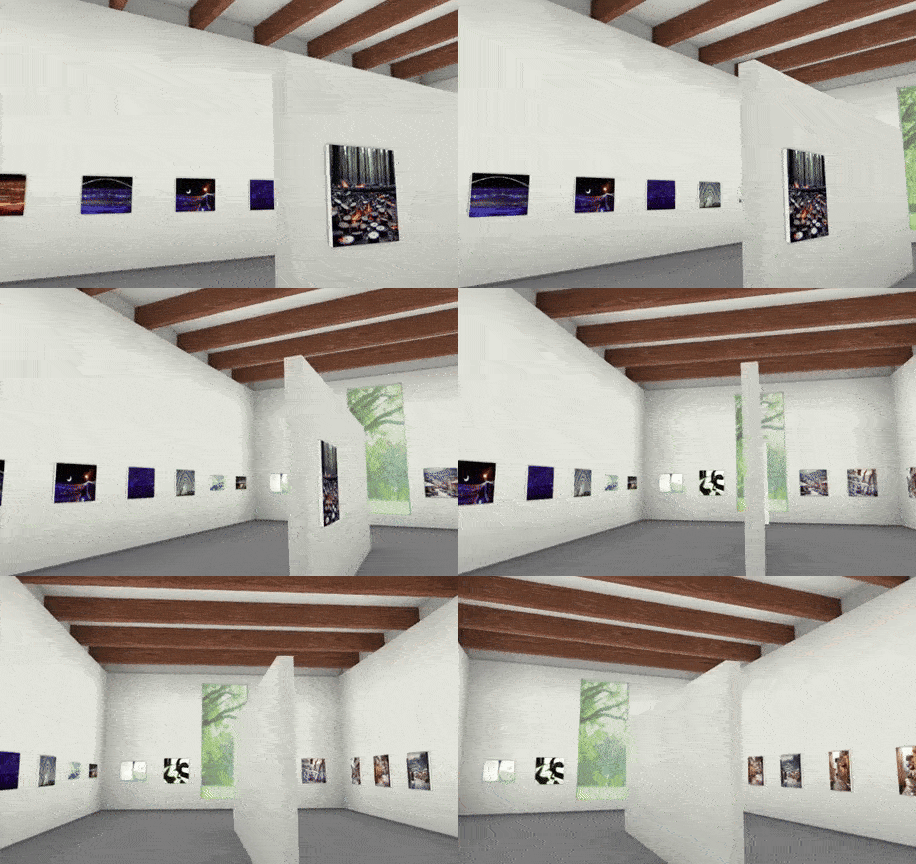
Later that evening, we spent several hours in his art gallery, surrounded by the very works that had emerged from these reflections. The paintings gave visual form to many of the ideas we had discussed throughout the day, deepening my appreciation of his artistic vision. What began as a chance encounter in Paris evolved into an ongoing intellectual exchange that continued throughout the following year through our conversations and correspondence after I returned to the United States. I remain grateful not only for Timothée’s generous hospitality but also for the intellectual curiosity, humility, and artistic sensibility that have enriched our dialogue.
Timothée spoke often of harmony, love, gratitude, and the desire to contribute something positive to the world through his creative work. He described himself not as a master but as a lifelong student, continuously exploring different artistic forms and techniques in an effort to express joy, contemplation, and a humble spirituality. Yet when I returned to his paintings after our conversations, I realized that the artworks themselves offered something more expansive than explanation. They invited contemplation rather than instruction, reflection rather than certainty.
Why a Metaphysical Inquiry?
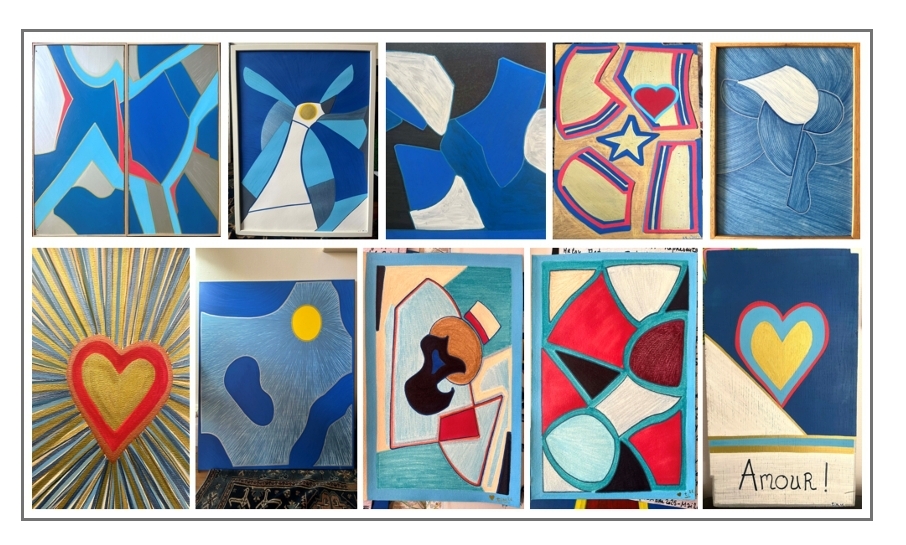
The decision to approach Timothée’s paintings (See Figure 1) through a metaphysical lens emerged partly from my own background in English literature. Throughout my academic journey, I developed a particular appreciation for the seventeenth-century metaphysical poets, especially John Donne, Andrew Marvell, and Henry Vaughan. What fascinated me was their remarkable ability to transform ordinary objects, spatial relationships, and geometric figures into meditations on love, faith, mortality, time, and existence. Geometry in their poetry was never merely mathematical; it became a language through which deeper questions of human experience could be explored.
While contemplating Timothée’s paintings, I found myself returning to this literary tradition. His recurring circles, radiant forms, divided spaces, and carefully balanced compositions seemed to invite a similar mode of reflection. Their geometries appear less concerned with mathematical precision than with the enduring human search for harmony, meaning, spirituality, and being. The paintings encourage viewers to move beyond surface appearances and enter a contemplative space where form becomes a vehicle for thought.
Harmony Through Fragmentation
At first glance, Timothée’s paintings appear deceptively simple. One encounters hearts, stars, suns, floral forms, luminous colors, and geometric structures arranged in harmonious compositions. Their visual language is accessible and welcoming, almost childlike in its sincerity. Yet prolonged observation reveals a complexity that exceeds initial impressions. These are not merely decorative arrangements of shapes and colors. They are visual meditations that operate simultaneously on emotional, spiritual, and philosophical levels.
One of the most striking features throughout the collection is the recurring tension between unity and division. Timothée frequently speaks of harmony, peace, love, and human connection. Yet many of his compositions achieve their harmony through separation rather than fusion. Hearts are enclosed within geometric boundaries. Circular forms radiate outward while remaining distinct from their surroundings. Flowers emerge through segmented structures. Color fields are divided into carefully organized regions that maintain both independence and relationship.
In this respect, the paintings seem to suggest that harmony is not the absence of difference but the successful coexistence of difference. Their visual language acknowledges boundaries without celebrating isolation. The works invite us to consider whether human existence itself may be composed of seemingly contradictory elements: joy and sorrow, solitude and companionship, faith and uncertainty, memory and hope. Rather than resolving these tensions, Timothée allows them to remain visible, creating compositions that feel both balanced and dynamic.
The Language of Color and Form
Color plays a central role in shaping the emotional atmosphere of these works. Blues frequently dominate the compositions, creating impressions of depth, tranquility, and openness. These expanses often evoke skies, water, or vast spiritual horizons. Against them appear warmer tones, reds, yellows, oranges, and greens, that introduce vitality and emotional intensity. The resulting interplay generates a visual rhythm between stillness and movement, contemplation and expression.
The geometric forms themselves contribute to this effect. Circles, radiating patterns, and carefully structured shapes create a sense of order, yet the paintings never feel rigid. Instead, they retain a lyrical quality that allows emotion and imagination to coexist with structure. Geometry here functions less as a system of measurement than as a language of contemplation. The forms seem designed not merely to be observed but to be inhabited mentally, encouraging viewers to linger within their symbolic and emotional possibilities.
The Search for Being
Ultimately, Timothée’s art succeeds not because it provides definitive answers but because it sustains meaningful questions. Beneath its bright colors and harmonious forms lies a thoughtful exploration of how human beings seek coherence within a fragmented world. The paintings remind us that beauty can emerge from division, that order can coexist with freedom, and that simplicity can contain unexpected depth.
As I reflect upon our conversation beside the Parisian River and my subsequent encounters with these paintings, I am left with the impression that Timothée’s artistic practice is best understood as an act of contemplation. His works invite viewers to consider not only what they see but also how they see, feel, remember, and believe. In this sense, his geometric art becomes more than a visual experience. It becomes a quiet meditation on the enduring human search for harmony, meaning, and being.
Timothée may describe himself as a learner, still exploring and learning through his creative journey. Yet there is quiet wisdom within these paintings. Their greatest achievement lies not in offering certainty but in opening a space where beauty, reflection, and wonder may continue to unfold long after the viewer has looked away.
Art Beyond Explanation
Throughout our conversation in Paris, Timothée repeatedly returned to themes of devotion, gratitude, humility, and love. The enduring strength of these paintings, however, lies precisely in their refusal to be exhausted by any single explanation. His artistic philosophy is rooted in a sincere desire to communicate positive values and to bear witness to moments of beauty, meaning, and spiritual reflection. Nevertheless, the paintings themselves extend beyond the boundaries of authorial intention, opening pathways to interpretations that even the artist may not fully anticipate.
France has long cultivated traditions of both artistic creation and philosophical reflection. Thinkers such as Roland Barthes and Jacques Derrida reminded us that meaning cannot always be confined to the intentions of a creator. Timothée’s paintings seem to participate in this openness. While their creator speaks of harmony, devotion, and love, the works themselves invite viewers into broader meditations on memory, longing, beauty, spirituality, and being.
One viewer may perceive spiritual transcendence; another may encounter nostalgia, serenity, hope, or quiet longing. Others may be drawn to the delicate balance between order and freedom, unity and fragmentation, that quietly animates the compositions. The paintings accommodate these diverse responses without losing their coherence. They do not impose a single interpretation. Instead, they create a contemplative space in which personal reflection becomes part of the artistic experience itself. Perhaps this is the most enduring achievement of Timothée’s geometric art. Rather than offering definitive answers, it encourages meaningful questions. The viewer leaves not with a conclusion, but with a heightened awareness of beauty, wonder, and the continuing human search for harmony and being.