











Klujev Alexander S.
The Herzen State Pedagogical University of Russia. Doctor Habil. in Philosophy, Full Professor. The Russian Institute of Art History
Leading Researcher – E-mail: [email protected]
Επιμέλεια: Εύα Πετροπούλου Λιανού
ON THE DEVELOPMENT OF COOPERATION
BETWEEN RUSSIA AND CHINA
IN THE FIELD OF EDUCATION:
AN IMPORTANT TURN
Abstract
The article notes active cooperation between Russia and China in various fields: military-technical, trade-economic, political, sociocultural. The importance of cooperation between Russia and China in the field of education is emphasized.
It is pointed out that in the established cooperation between Russia and China in the field of education, China’s activity and Russia’s less active participation are noticeable. Attention is drawn to the need for Russia to more persistently defend its interests in the field of education.
The author suggests some ways to strengthen Russia’s position in Russian-Chinese educational cooperation, using the example of organizing classes at the Herzen State Pedagogical University with Chinese citizens.
Keywords: Russia, China, Chinese citizens, education, educational classes, Herzen State Pedagogical University of Russia.
Today, there are a huge number of documents certifying the cooperation between Russia and China in various fields: military-technical, trade-economic, political, and socio-cultural. In my opinion, strengthening cooperation between Russia and China in the field of education is particularly important. Why?
The reason is that education helps people to become more cultured, which leads to friendship and good-neighborly relations.
In Russian-Chinese cooperation in the field of education, exposure to culture occurs because Russian citizens are exposed to Chinese culture, and Chinese citizens are exposed to Russian culture.
It is no secret that Chinese citizens actively engage Russian citizens in their culture (for example, the “Chinese Belt and Road Initiative”, which is not limited to its stated trade and economic goals). But what about Russia’s efforts to expose Chinese citizens to its culture? (I emphasize that it is Russia’s culture. In recent years, unfortunately, many cultural figures in Russia, guided by Western standards, have shown Russophobia and see Russian culture only as “Russian dead ends”).
Of course, Russia is also introducing its own culture to the Chinese people, as evidenced by the hosting of festivals of traditional Russian culture in China and the display of works by genuine (non-pro-Western) Russian artists, writers, composers, directors, and so on. However, this is not enough. I work at the Institute of Music, Theatre and Choreography at the Herzen State Pedagogical University, and given the large number of Chinese students at our Institute – we have about 500 Chinese postgraduate students alone (and this is only the beginning!), I have proposed some ways to increase the involvement of Chinese students in Russian culture as part of my professional activities at the Institute: teaching music courses.
What I have proposed for working with Chinese students (bachelors and masters):
– pay more attention to mastering the works of Russian composers (M.I. Glinka, M.P. Musorgsky, A.P. Borodin, P.I. Tchaikovsky, N.A. Rimsky-Korsakov, V.S. Kalinnikov, A.N. Scriabin, S.V. Rachmaninov, A.A. Arkhangelsky, A.D. Kastalsky, P.G. Chesnokov, G.V. Sviridov and others), as well as genres of Russian music (especially spiritual);
– to gain a deeper understanding of the scientific works of Russian and foreign scholars on Russian music (V.F. Odoevsky, V.V. Stasov, B.V. Asafiev, S.V. Smolensky, Yu.V. Keldysh, E.M. Orlova, I.E. Lozova, T.F. Vladeshevskaya, N.S. Seryogina, E.G. Meshcherina; J. Haasen, J. Abraham and others);
– to participate more actively in scientific conferences with topics devoted to Russian music, and to scientists who have studied Russian musical culture;
– to regularly attend concerts and musical performances that introduce the masterpieces of Russian musical classics (of course, avoiding performances of these works in Western-style modifications that distort their essence).
Due to the fact that I have a personal website, I have come up with an original form of work: to choose one of the works posted on the website that is dedicated to Russian musical culture and to analyze this text. Here is one of the results of such an analysis (the style of the author of the analytical essay is preserved):
ABOUT THE RUSSIANNESS OF RUSSIAN MUSIC (article by A.S. Klujev)
The topic of the article is the Russianness of Russian music. The discussion of this topic is very relevant today. The article first explains what Russianness is. Many people believe that Russianness is a national characteristic of Russians. However, the article denies this. According to the article, not all Russians by nationality have Russianness. On the contrary, people of other nationalities (such as French and German) can be carriers of Russianness.
The article proposes a new definition: “Russian person” is not a national identity, but a spiritual identity. Such people believe in Orthodoxy. For them, Russianness is the Radiance of God’s Power and Glory.
Then the article applies this definition to the study of music.
The Russianness of Russian music has its roots in the ancient Russian Orthodox chant. Chant is the prayerful singing in an Orthodox church. This singing existed until the mid-17th century, when it was replaced by partes. However, it did not disappear, but rather went into hiding in the depths of history. Later, it manifested itself three times in different forms of Russian music, known as the three fires.
The first glow occurred in secular music, in Mikhail Glinka’s opera “A Life for the Tsar” (“Ivan Susanin”). Before writing the opera, Glinka worked on a “Cherubic Song” in the style of znamenny singing. He did not complete this song, but he used its ideas in the finale of the opera, “Glorify”.
The second glow occurred in church music, in Tchaikovsky’s “Liturgy of St. John Chrysostom”. Tchaikovsky wanted to revive ancient church singing. He used elements of znamenny singing and repeated “Hallelujah” 11 times in his “Cherubic Song” (usually only 3 times) to express endless jubilation.
The third glow appeared in secular-church music, in Sviridov’s “Chants and Prayers”. This piece is performed on stage, but it has a liturgical meaning. Sviridov used a two-chorus format, which creates the effect of a “mysterious glow of choral harmonies”.
At the end of the article, it talks about the ringing of bells in Russian music. The ringing of bells is the brightest shining of the znamenny singing, therefore it is the most powerful expression of the Russianness of Russian music.
The most intriguing aspect of the article is its new definition of Russianness. Previously, many studies associated national culture with blood. They believed that the culture of a nation could only be passed down through its members. However, the article challenges this notion. It argues that the core of culture lies in spiritual faith, not blood. For example, St. Maximus the Greek was a Greek by nationality, but he became an important contributor to the Russian spiritual tradition. This is confirmed by the 观点 of the article.
This perspective helps us understand why people of other nationalities can create works with a Russian soul. It also opens up new avenues for cultural research, as the boundaries of culture are not limited to national borders but are influenced by spiritual beliefs.
In general, the article is not limited to the analysis of musical style. It interprets the core of Russian music through the lens of faith.
The article clearly explains the essence of Russianness and shows that the ancient religious tradition continues to influence artistic creation through the ages and different types of music.
Wang Hao
(Master’s student at the Institute of Music, Theater and Choreography Herzen State Pedagogical University of Russia)
Here is what I have proposed in my work with Chinese postgraduate students:
– to choose topics for dissertation research related to the study of the scientific work of contemporary Russian scholars whose research focuses on various aspects of Russian musical culture, as well as the study of the specific features of Russian music (including the peculiarities of Russian musical thinking). Currently, I have four Chinese postgraduate students. The names of these postgraduate students and the topics of their dissertations are as follows:
1. Wang Shuwen: “Issues of Musical Aesthetics in the Works of E.G. Meshcherina”.
2. Li Xiang: “Musical and Aesthetic Issues in the Works of N.S. Seryogina”.
3. Li Shiquan: “The St. Petersburg (Leningrad) School of Musical Aesthetics”.
4. Cai Jianming: “Russian Music: Main Stylistic Features”.
– to establish contacts between Chinese and Russian teachers (ensuring the exchange of scientific publications between Chinese teachers in Russia and Russian teachers in China; joint presentations at scientific conferences in China and Russia; personal communication);
– to publish materials on the topics of their dissertations not only in Russia but also in China;
– to present topics related to their dissertations at scientific conferences not only in Russia but also in China.
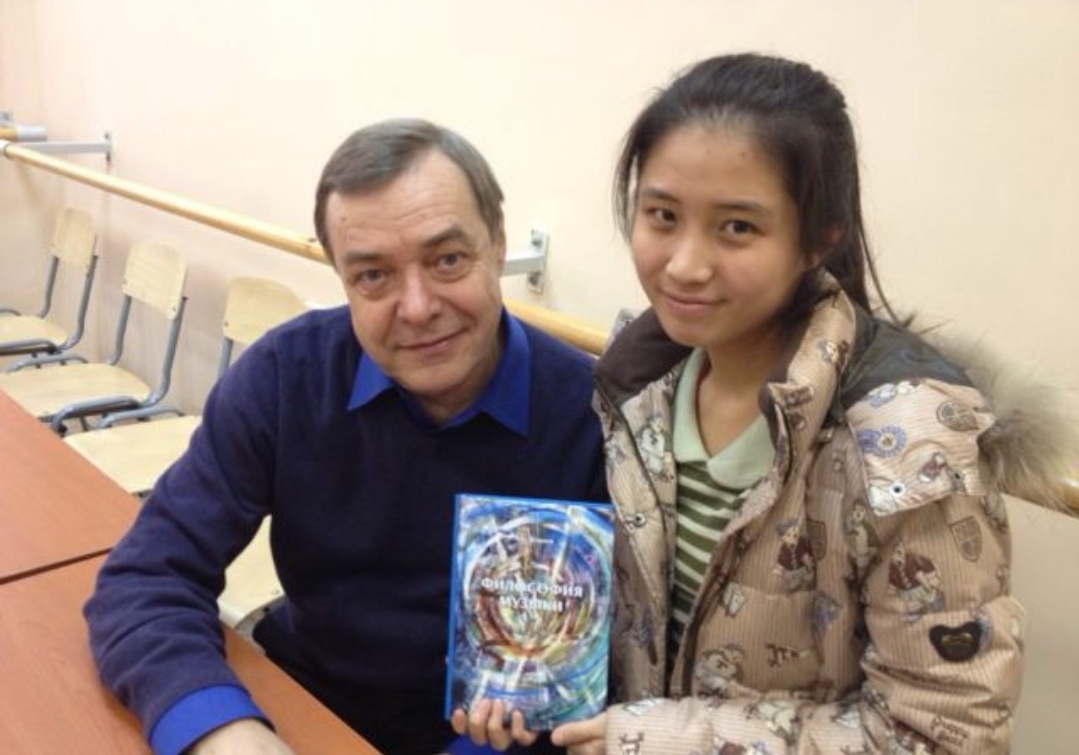
In addition, I have organized the publication of my textbook on Russian musical culture in China. The textbook will be published in both Chinese and Russian for Chinese citizens studying at our Institute. Here is information about this publication (also in both Chinese and Russian):
亚历山大·克柳耶夫
Alexander Klujev
音乐:俄罗斯经验
MUSIC: THE RUSSIAN EXPERIENCE
而不是序言
本选集收录了本人关于音乐的若干文章。其中本人尝试以一种独特的视角——即俄罗斯文化永恒价值的视角来审视音乐。
的确,对俄罗斯人而言,音乐意味着什么?在那些深受俄罗斯精神不朽功绩熏陶的人们的心中,音乐向世界传递着怎样的意义与内涵?
谨望本集能够引发读者的阅读兴味。
Instead of a preface
The textbook contains articles on music, in which the author tried to look at music from an unusual point of view – from the point of view of the eternal values of Russian Culture.
Indeed, what does music mean for a Russian person? What meaning, what content does it bring to the world in the understanding of a person brought up on the examples of the IMMORTAL DEEDS OF THE RUSSIAN SPIRIT?
目录 / CONTENT
而不是序言/ Instead of a preface
文章 / Articles
1. 音乐哲学的当代镜像(总论)/ Philosophy of Music in the Mirror of the Contemporary Age (General remarks)
2. 音乐游戏:几时方休?/ Game of Music: How Long?
3. 现象学视域下的音乐教育、教学与培训 / Musical Upbringing, Education and Training in Phenomenological Understanding
4. 俄罗斯音乐学:过去、现在与未来 / Musicology in Russia: Past, Present, Future
5. 论俄罗斯音乐的“俄罗斯性”/ About the Russianness of Russian Music
6. 俄罗斯哲学家论音乐 / Russian Philosophers about Music
7. 音乐的预感(谈尼尔·索尔斯基) / Premonition of Music (Nil Sorsky)
8. 流浪的长笛手(论音乐在格里高利·萨维奇·斯科沃罗达生命中的地位)/ The Wandering Flutist (about music in G.S. Skovoroda’s life)
9. 音乐颂 :弗·费·奥多耶夫斯基公爵 / Hymn to Music: Prince V.F. Odoevsky
10. 作为礼拜仪式的音乐(谈神父帕维尔·弗洛连斯基) / Music as Liturgy (f. Pavel Florensky)
11. 音乐哲学的基本问题 (据阿·费·洛谢夫的观点) / The Main Question of the Philosophy of Music (according to A.F. Losev)
12. 尼·奥·洛斯基的音乐哲学 / N.O. Lossky’s Philosophy of Music
13. 伊·伊·拉普申哲学研究中的音乐 / Music in I.I. Lapshin’s Philosophical Studies
14. 叶·尼·特鲁别茨科伊公爵对音乐意义的阐释 / The Sense of Music interpreted by Prince E.N. Trubetskoy
15. 新协同音乐哲学的原理 / Principles of the New Synergetic Philosophy of Music
附录
亚历山大·克柳耶夫接受哥伦比亚哲学家泰隆·阿丘里采访的访谈录…/
Appendix
Interview with Alexander Klujev
by the Colombian philosopher Tayron Achury
And at the end. I hope that the important turn I have outlined in the development of China-Russia cooperation in the field of education will become a significant component of the already dynamically gaining momentum renewal of science and education in Russia (1).
(1) See: Klujev A. Science and Education in Modern Russia – the Hour Has Come (Based on a report made on November 11, 2025, in Moscow, at the Russian Academy of Sciences, at an international scientific and practical conference dedicated to the problems of science and education in modern Russia). In: [El.] https://credo-new.ru/archives/3489 [more concise: [El.] https://izborsk-club.ru/27712].