











INTERVIEW by: Eva Lianou Petropoulou
Dr. Anand, what is your opinion about Literature in general? Literature runs parallel to history, it is emotional cardiograph of an era. What actually happens forms the reality of a time, and this reality enters the pages of history. History records gives us only a CCTV view of what happened. But, the reach of literature is far deeper. It enters the minds of the actors, and confronts their personal moments in their emotional intensity. It deals with the why of happenings, which actually involves the study of human motives. From history, we have only a skeletal view of events. To understand the phenomenon behind an event, we need to enter them, and it is possible only through the literary works, which are embedded in man’s psychology, his thoughts, his feelings, his cravings, deprivations, and above all, his imagination. Literature lends to life an aesthetic dimension which makes it look bearable, even if we are witnessing the worst of events with our own eyes.
What is fear? When we possess something, fear relates to the idea of losing it. We are blessed with life, and the fear of death is our most constant ally. Fear is an agent of the state. In a way, fear is also an unrefined form of discipline. If you break the discipline, you are meted out punishment. So, punishment is a fear that lurks in our minds. Fear also suggests that there is something or somebody who is superior to us, and wants better performance from us, and might ask us to explain. In other words, the fear of angels who are always watching us. Fear mostly relates to the unknown. What we know we know, what we don’t know, falls in the realm of darkness. And darkness generates fear. Hell is the greatest fear, which has been used to keep men on the right path.
Why do you use AI in reviews of your poems although a lot of people believe that AI products are most stolen products and they have used many materials without the consent of authors, researchers and several personalities? AI is still evolving and its borders remain porous, and, at present it appears to be a free for all. Its possibilities are unlimited, and in addition to the good that it has done to us, the fear remains that it has the potential of doing great damage to human society. I look at AI as if more water is released into your throat than it can handle, or more air is pushed into your lungs than they can stand. It can burst the lungs. The basic idea is: the limit, the restraint which must accompany every new invention. They always mention safeguards. But, how seriously we take them depends on us.
I look upon AI as a highly advanced state of technology, and man must make maximum use of it. Just as we use electricity. But, the final decision again lies with man: Use everything with restraint. We would not like to ride in a car whose brakes do not work. AI can change the face of mankind faster than we can imagine. Men have to understand this thing. If the ‘jinn’ comes out of the bottle, then it depends on what command we give.
Why I use AI for reviews of my poems? The simple reason is that AI is able to look over the entire spectrum of literature, and compare it with other poets’ work, and place it in the right perspective. We also know where we stand viz a viz world writing.
What is the image f the future? Do you believe that humanity will survive? I think man is losing his patience, as well as his mental balance. Wealth, prosperity and selfishness are the ruling passions, and exalting selfhood highest of all. The leaders who are expected to be mature in ideas have been replaced by small time leaders who can manage majority in order to stay in power, but they pursue an agenda which is self-centred. Personal glorification is at the centre of all human thought, and leaders are no exception. In the modern world, the scholars, who are the reservoir of wisdom, have been pushed into the margins, so that those who take decisions have nothing to do with higher thought. The result is before us. A civilization baked in knowledge, hates wisdom, lives on smart solutions and believes in instant success.
At this speed, we are rushing towards our own doom, faster than anyone could conjecture. We are a highly enlightened and highly empowered race, laced with science and technology. Only we should learn to live with our knowledge, keep it under check, and use our resources for the good of mankind, and the cosmic spread.
Ancient Greece and Myths of India What is the connection, What is the difference between those civilizations? Both the civilizations are ancient civilizations which share linguistic and historical roots. But the temperament of the two civilizations is different, rather I would call it complementary. We need to put the two civilizations together to have a complete view of mankind as it evolved from antiquity.
Greece is rooted in humanism, rationalism, and empirical philosophy. Interest in mathematics, democracy and rational debate shaped a world view which believed in the pursuit of reason and the capabilities of mortal men. On the other hand, Indian world view is defined by spiritualism, metaphysics, and a holistic view of the cosmos, encompassing Hinduism, Buddhism, and Jainism. Indian philosophy is characterised by the concept of Dharma, cyclical time and the pursuit of ultimate liberation [Moksha].
So far as state is concerned, Greeks experimented with city states [polis] and democratic rites like voting by citizens. In India, the state was structured around monarchies. Moreover, the Greeks faced significant shifts through Roman era, Christianity and modernization, while India has shown a remarkable living continuity supported by ancient texts.
Young people and social media. What is your opinion about this? This is the age of social media. It is a phenomenon which has overtaken our contemporary world, and it cannot be reversed, nor ignored. In fact, like an earthquake, it has affected every mind, young or old. If you do not accept this reality, you will be left behind. I think there is no point in trying to condemn this phenomenon. These are the fruits of science and technology, which are actually a response to man’s expanding needs. Just imagine, can we think of a life without a mobile phone? Can we expect to live quality life in the absence of internet? Social media has really made the world into a global world, it is another thing that this world is emotionally, psychologically and sociologically fractured. The world has moved away from the certitude of the printed media. Now, with AI zoom, there is fear of fake news, and fake identities. Men are using AI at an extensive scale, which causes alarm. Finally, I think we have to live with this revolution, and we should keep the control in our hands. We should be able to choose and direct this phenomenon, rather than falling a victim to its vagaries.
Ethics. We are in a world where everything is used. Even people get manipulated. What is your opinion? You are right, the contemporary world has lost its moral axis. The development of science and technology has thrown human life open to all types of temptations. Even institutions like religion have failed to put a rein on human passion and inordinate ambition. Education fuels the fire of unbridled passion for higher packages, wealth and luxury. People have removed ‘peace and happiness’ from the agenda of a successful man. The worst development is that in the past, at least elderly men would talk of honesty, goodness, and fairness. Now, the elderly men have been victims of the consumerist culture and they have nothing to offer by way of advice to their upcoming generations. We are living in a morally rotten ecosystem, where family, school and religious institutions have fallen apart.
I think the greatest damage has been done by lopsided educational policies. We have focused man on material things. Knowledge itself has satanic roots, we should not forget, Eve forced Adam to eat the fruit of knowledge, which God had forbidden. So, knowledge without wisdom is a dangerous equipment, which has already destroyed humanity. If we want to salvage mankind from self- destruction, we have to stop and think. And focus on creating better men. We must have an ethical alphabet, instead of the traditional alphabet which teaches A for apple. We must start with E for Ethics, and K for Kindness.
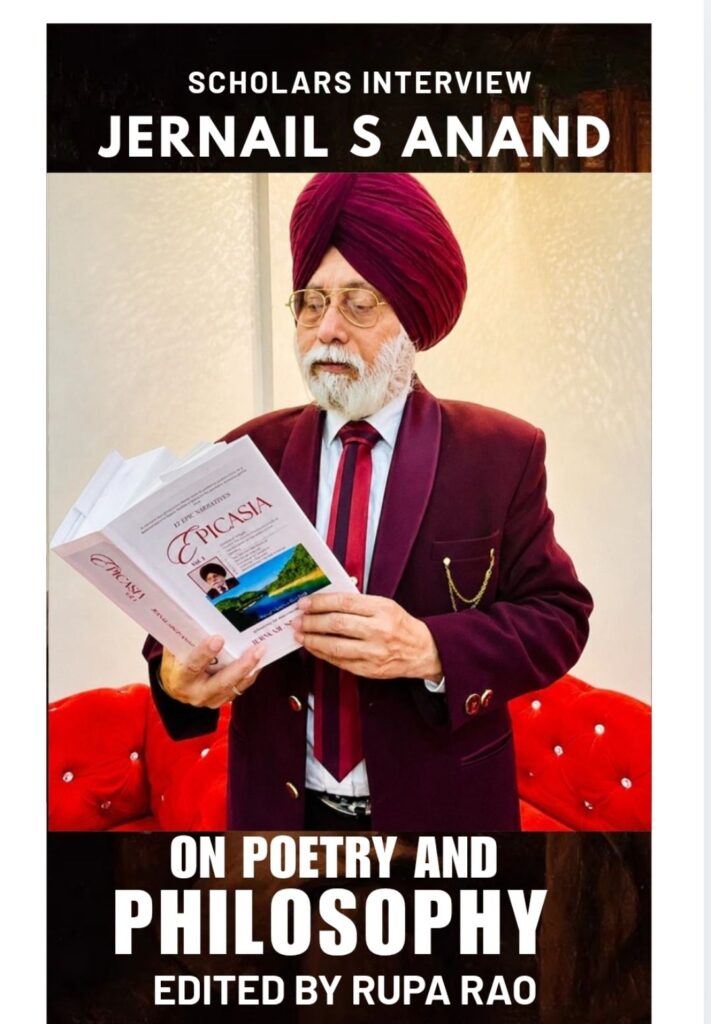
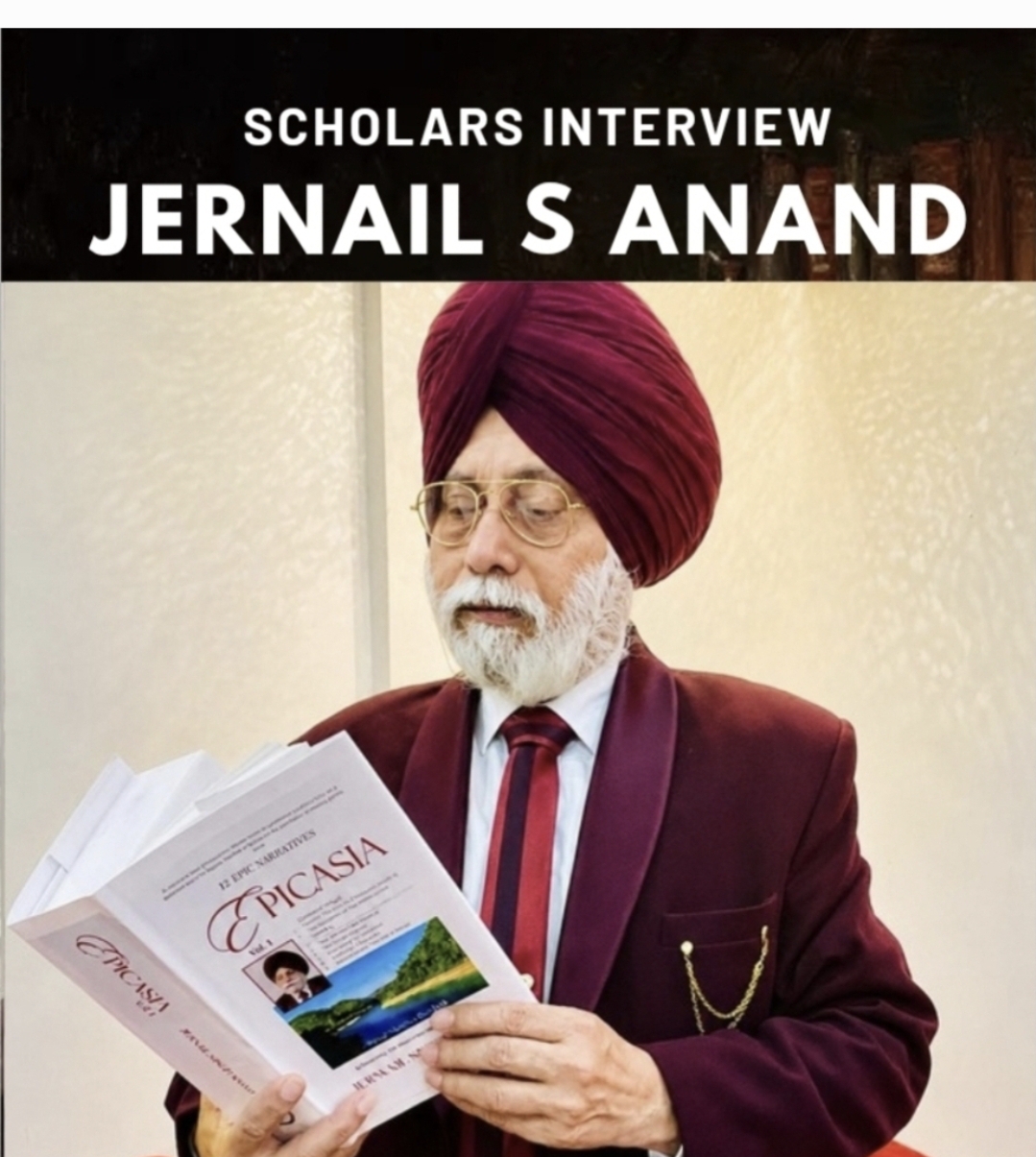
Bio of Dr. Jernail S. Anand
Dr. Jernail S. Anand, with 200 books to his credit [18 epics] is a Chandigarh-based top ranking presence in the contemporary world literature, a polymath, and a vital architect of the 21st century ethical literature whose seminal work ‘Lustus: The Prince of Darkness’ challenges the moral complacency of our era. Founding President of the International Academy of Ethics, and Laureate of Charter of Morava [Serbia], Seneca [Italy], Franz Kafka [Germany, Ukraine, Czeck Rep] and Maxim Gorky [Russia] Soka Ikeda and Mahakavi Bharati (India) Awards, his name is inscribed on the Poets’ Rock in Serbia. He is an Honorary Member of the Serbian Writers Association, Belgrade, a Member of the Honorary International Boule and Honorary Academic Senator of International Academy of Rome, and a Academic Member of the Academy of Arts and Philosophical Sciences, Bari [Italy], Lifetime Vice President of Korean Association of World Literature. He is International Honorary President of COLOSSEUM, International Literary Prize 2026 by International Academy of Rome.
Anand has built a poetics that unites ethics, Vedic spirituality, social critique, and the philosophy of meaning. Anand presents an articulated perspective on poetry as an instrument of planetary consciousness. A moral philosopher, professor, and international speaker, Anand has devoted much of his research to the ethical dimension of language, to the responsibility of the individual within a globalised society, and to the relationship between matter, consciousness, and transcendence. Email: [email protected].
Bibliography:
https://sites.google.com/view/bibliography-dr-jernal-singh/home
Grokipedia:
https://share.google/QtiWrcFr7Sca7v0qC
CHANDIGARH. 22 JUNE, 2026.
EVA PETROPOULOU-LIANOU, an award-
winning Greek children’s author and poet, is a Peace Ambassador and international literary representative. A journalist-turned-writer, she has published numerous books, contributed to global cultural projects, and earned major honors including Books for Peace (UNESCO) and the International Nelson Mandela Peace Award. She is a 2024 Nobel Peace Prize nominee.