









Επιμέλεια: Εύα Πετροπούλου Λιανού
We have emerged from the past throwing off superstition and the stranglehold of religion which served as boobytraps to obstruct man’s march into modernity. However, while we have entered the shining horizons of scientific advancement, and are looking over the AI into further areas of deep research, it is alarming to see how man is conceding more and more space to the machines. We must ask this question to ourselves: What is our destination? Shall our science ever succeed in trapping death? Shall we ever be able to demystify the process of birth and death? Physically, and clinically, science can explain the phenomenon of birth and death, but the question remains : what dies with the body? And what comes to life with the birth of a child? These are eternal questions which have foxed human intelligence, artificial or otherwise.
The fall of mankind in the Eden proved to be a blessing in disguise. The pursuit of knowledge has given us this great civilization. But all is not well with the human tribe. Perhaps, in our euphoria about technological progression, we forget that knowledge has devilish roots. It was Satan who had tempted the mother of mankind. The results are obvious. In these times of great advances of science and technology, we are witnessing another fall, and now it is the fall from human graces.
The Second Fall: The Fall from Human Graces
There are obviously two forces which are responsible for the second fall of mankind. Man can be healthier and might be living longer and more comfortably than before. But the subject of real worry is his emotional disintegration. His mindscape is a web of confusions, deprivations and longings. He has been brought to this alarming situation by the flurry of physical comforts, the innovations, and the power and luxury which has been placed at his disposal in the name of modernity and advancement. Now, AI, which promises to solve his problems, is itself viewed as a fearsome monster for the human kind, because there are no ways to restrict this menacing development of technology.
Ethical Neutrality of Literature
The second issue relates to the moral support which was eminently available to mankind in the previous ages, and it was the support of literature. With the progression of civilization, there is no dearth of literary writings. Amazon is flooded with books and writers, competitions and awards. But, we have not been able to produce literature whose moral intensity matches the masters like Shakespeare and Milton. No doubt, there have been democratization of the creative process, but the progression of civilization has diluted the moral content of previous centuries, and there is visible erosion of the ethical in the contemporary literature. The prevailing ideas of aestheticism, and moral neutrality of the author restrict him from taking a moral stand, because he is then accused of preaching or pontificating.
The idea of freedom in matters of literary expression has been dragged to such an extent, that the reader is accorded the freedom to reconstruct his own text, which makes him a creator in his own right. The movements like Art for Art’s Sake further removed the burden of moral necessity from the shoulders of the artists. Moreover, the number of people who are writing about literature, has increased manifold over those who are actually creating literature. The creative writer too stops short of making any direct assertions because being explicit in areas of morality is treated as a lower art. Artists create their art works, and leave it to the masses to understand the message in their own way. It can be defended in many ways, except one. A writer has a cosmic responsibility to create in order to ensure the wellbeing of the universe. And what he says, he should have so much power over his words that they cannot be hijacked or forced to mean anything else.
Moral Ambiguity of Literature
I think this tendency of the literary world, this moral ambiguity and not taking a particular moral stand, and saying things in an abstract manner, so that it allows the people to come to their own conclusions, which finally means freedom to interpret, needs to be re-evaluated. If we compare the moral intensity of the literature of Shakespeare’s time, through Milton, Donne and William Wordsworth, we find that our century has more poetry, prose, fiction and non-fiction, and it is loaded with much more critical mass, yet, we are far behind them, so far as undeclared moral commitment of the writer is concerned. I think this is one reason why the world has tumbled into moral chaos.
If we wish to put brakes on the free fall of human civilization into insanity, we need to make literature more morally pronounced. Let every writing, creative or critical, or even scholarly works, clearly mention what moral purpose it serves. I call it ‘ethiquettes’. We will have to come out openly, and while writing, promote ethical living. Otherwise, our ethical neutrality will push the civilization further and deeper into moral anarchy and emotional bankruptcy.
DR JERNAIL S ANAND
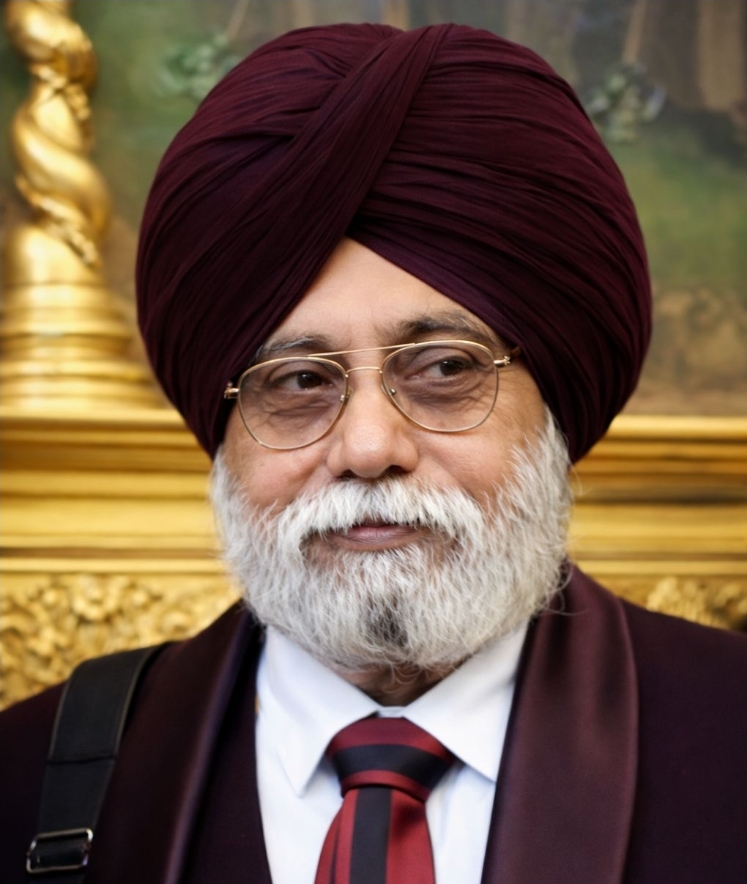
Dr. Jernail S. Anand, with 200 books to his credit [20 epics] is a Chandigarh-based polymath, and a vital architect of the 21st century ethical literature whose seminal work ‘Lustus: The Prince of Darkness’ challenges the moral complacency of our era. Founding President of the International Academy of Ethics, and Laureate of Charter of Morava [Serbia], Seneca [Italy], Franz Kafka [Germany, Ukraine, Czech Rep] and Maxim Gorky [Russia], his name is inscribed on the Poets’ Rock in Serbia. He is an Honorary Member of the Serbian Writers Association, Belgrade. Anand has built a poetics that unites ethics, Vedic spirituality, social critique, and the philosophy of meaning. Anand presents an articulated perspective on poetry as an instrument of planetary consciousness. A moral philosopher, professor, and international speaker, Anand has devoted much of his research to the ethical dimension of language, to the responsibility of the individual within a globalised society, and to the relationship between matter, consciousness, and transcendence. Email: [email protected].
Bibliography:
https://sites.google.com/view/bibliography-dr-jernal-singh/home
https://share.google/QtiWrcFr7Sca7v0qC