








Lan Xin (Lan Xin)
World Memory Heritage The Only Female Inheritor of Dongba Culture, International Renowned Writer & Poet. Internationally Renowned Chinese-English Bilingual Writer. The Only Female Inheritor of the World Memory Heritage Dongba Culture, Dean of China Yulong Wenbi Dongba Culture Academy.
Eva Lianou Petropoulou
Αποκλειστικη Eκπρόσωπος για την Ελλάδα για την προώθηση της πολιτιστικής κληρονομιάς – Dongba Culture Κίνα
PS: I sincerely recommend scheduling the publication of the article A New Chapter for the Year of the Horse: The Sacred Mission of Horses in Dongba Culture and the Resonance Between Chinese and Greek Civilizations between February 14 and February 16, 2026 (which falls 3 to 1 days before Chinese Lunar New Year’s Eve of the Year of the Horse 2026). This period coincides with the pre-heating phase of the Chinese Spring Festival, allowing the article to ride the wave of festive atmosphere and better attract readers’ attention to the culture of the Year of the Horse and the civilizational resonance between China and Greece.

A New Chapter for the Year of the Horse: The Sacred Mission of Horses in Dongba Culture and the Resonance Between Chinese and Greek Civilizations by Lan Xin (Lanxin Samei)
Internationally renowned writer and poet, the only female inheritor of the World Memory Heritage Dongba Culture, Dean of the Yulong Wenbi Dongba Culture Academy of China, Winner of International Literary Awards
The year 2026 will usher in the Year of the Horse in the Chinese lunar calendar. In Greek mythology, the Centaur (Kentavros) is the embodiment of wisdom and strength, taking the sacred form of a half-human, half-horse creature and serving as a medium connecting the mortal world with the divine realm. In the distant East, within Dongba Culture, a World Memory Heritage, horses also carry a sacred connotation that has spanned thousands of years—they are guides of souls, guardians of covenants, and disseminators of civilization. The universal wisdom embodied in them strikes a profound, cross-temporal chord with the perception of “sacred creatures” in Greek civilization.
Dongba Culture regards horses as the sacred mounts of souls, which bears a striking similarity to the sacred beings that guide the deceased in Greek mythology. The Dongba classics The Origin of Horses and Offering Sacrificial Horses to the Nether World record that horses are the guides leading the souls of the deceased back to the divine domain of their ancestors. Since ancient times, the Naxi people have upheld the tradition of “riding fine horses in life and offering sacrificial horses to the nether world after death”.
During solemn funeral rituals, the Dongbas—the clergy of the Naxi people and core inheritors of Dongba Culture—recite scriptures and offer horses, using sacred ceremonies to help the souls transcend the barrier between life and death. This is just like the envoys who guide souls across the River Styx in Greek mythology, building a gentle bridge for the cycle of life. Such reverence for horses stems from a profound insight into the essence of life—horses are not only companions in the mortal world but also ferrymen in the spiritual realm. This sacred attribute of “connecting two realms” has enabled the two ancient civilizations of China and Greece to reach an implicit agreement on the contemplation of life.
According to Dongba scriptures, the primal covenant concluded between humans and horses at the dawn of creation embodies the core tenet of Dongba Culture: “All things have spirits; respect heaven and love people”. This is in perfect harmony with the concept of “harmonious coexistence with nature” advocated by Greek civilization. When the Twelve Chinese Zodiac Signs came into being, horses and humans swore an oath before the gods: “Humans may eat the meat of other livestock and wear fur coats made from other animals, but they shall never eat horse meat or wear horsehide coats”.
In return, horses pledged to serve humans faithfully throughout their lives, carrying goods and overcoming obstacles with perseverance and loyalty. This mutual agreement is not a one-sided demand but a reflection of the wisdom of mutual respect between humans and nature. To this day, the Naxi people abide by this ancient precept, abstaining from horse meat and regarding horses as sacred companions—much like the ancient Greeks who revered nature deities, cherished the connection with all living things, and practiced the eternal law of “harmonious coexistence” through their actions.
In Dongba mythology, the horse is even more of a sacred messenger of cultural communication. Its mission of “seeking wisdom” is intrinsically connected to the spirit of Greek heroes who overcome hardships and dangers in pursuit of truth. Lahu Lasha, a human emissary, rode a white horse to the heavenly realm for help many times, bringing blessings to the mortal world. When Dongba Shiluo, the ancestor of Dongbaism, descended to the human world to subdue demons and eliminate evils, he also rode a white horse, coming down from the sky.
The horse’s speed and stamina make it a bridge connecting time and space. In The White Bat’s Quest for the True Scripture, a classic myth of the Naxi ethnic group in China, Lawu Lasha, the human emissary, rode a white horse, while the white bat rode an eagle. Together they ascended the eighteen layers of the heavenly realm to seek the true scripture from Panzi Samei the goddess of wisdom and the ancestor of human divination, bearing witness to humanity’s persistent pursuit of wisdom (My Dongba name, Lanxin Samei, derives from the name of this goddess, and there is a profound bond between us. I will share more details in the future).

This is very similar to the narratives in Greek mythology where heroes ride mythical beasts to venture into mysterious lands in search of truth, highlighting the common admiration of different civilizations for “courageous exploration” and “perseverance in mission”.
As living witnesses to cultural integration, the marks left by horses on the Ancient Tea Horse Road are comparable to the cultural exchanges achieved by Greek civilization through trade and migration. In ancient times, horse caravans carried tea, scriptures, and goods, traversing the regions of Yunnan, Sichuan, and Tibet, and promoting the integration and coexistence of diverse ethnic cultures. The perseverance and loyalty of horses have become a spiritual totem of the Naxi people, symbolizing the virtues of inclusiveness and progress.
The character for “horse” in Dongba pictographic writing features bold and unrestrained lines, often appearing in Dongba paintings and sacrificial artifacts, conveying the vigorous power of life. This resonates deeply with the depiction of dynamic beauty in mythical beasts and the praise for vitality in Greek art.
The monumental scroll The Origin of Horses, a pictographic work created by my Dongba master—Aheng Dongta, the 17th-generation Dongba inheritor, Dean of the Dongba Culture Academy, and UN lecturer on Dongba Culture—has been permanently collected by the China National Museum of Arts and Crafts and the China National Intangible Cultural Heritage Museum, standing as an exquisite embodiment of the charm of Dongba calligraphy.
The pictographic characters are a seamless blend of image and text: the strokes fall with a powerful cadence like the hoofbeats of a galloping horse, and the lines flow gracefully like a fluttering rein.
From the wise legends of the Centaurs in Greek mythology to the sacred mission of horses in Dongba Culture, despite the vast mountains and seas separating them, different civilizations share an astonishing convergence in their perception of “sacred creatures”—all symbolizing connection, loyalty, courage, and harmony.
The year 2026, the Year of the Horse, is not only an auspicious year for China but also a wonderful opportunity for the mutual learning between Chinese and Greek civilizations. As the Dean of the Yulong Wenbi Dongba Culture Academy of China and the only female inheritor of Dongba Culture, I hope to further promote cross-cultural exchanges between China and Greece in the new year.
Let us follow this cross-temporal resonance of wisdom, fulfill our missions with the perseverance of horses, safeguard covenants with the loyalty of horses, and embrace the future with the boldness of horses. In the new year, let us continue to write a beautiful chapter of harmonious coexistence between humans and nature, and mutual learning and common prosperity between Chinese and European civilizations!
Finally, on behalf of the Dongba Culture Academy, I wish readers around the world: a Happy Year of the Horse and may all your endeavors be crowned with success!
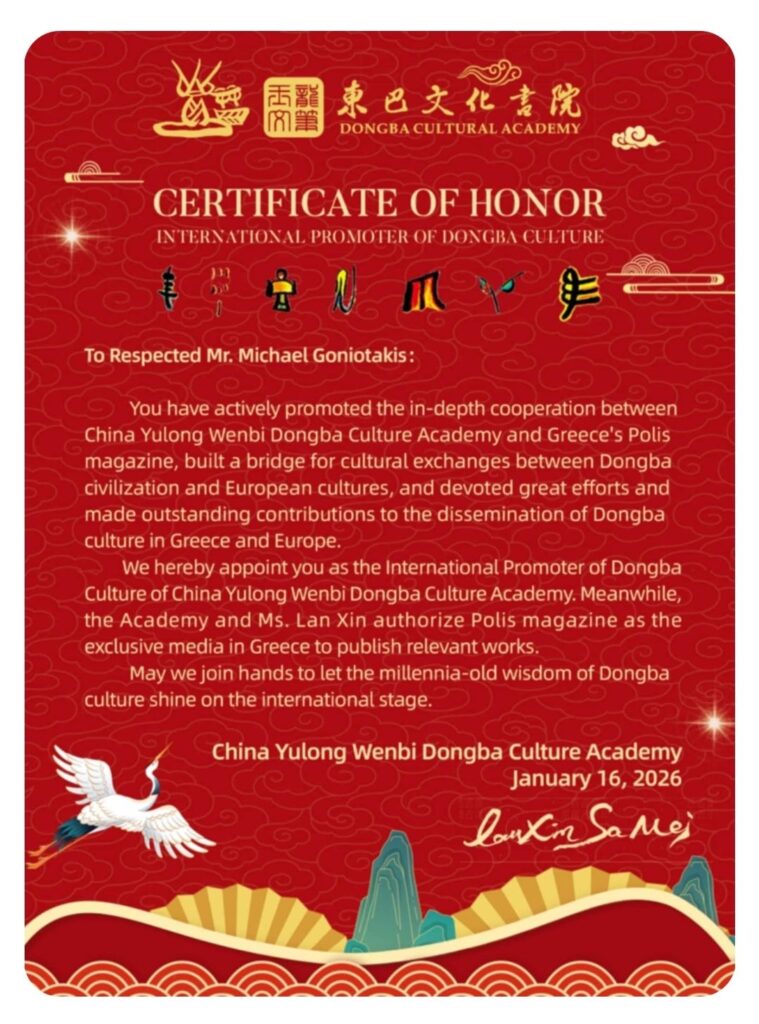
Media partner www.Polismagazino.gr
Αποκλειστικός εκπρόσωπος τύπου για την προώθηση της πολιτιστικής κληρονομιάς
Dongba Culture China