





Επιμέλεια: Εύα Πετροπούλου Λιανού
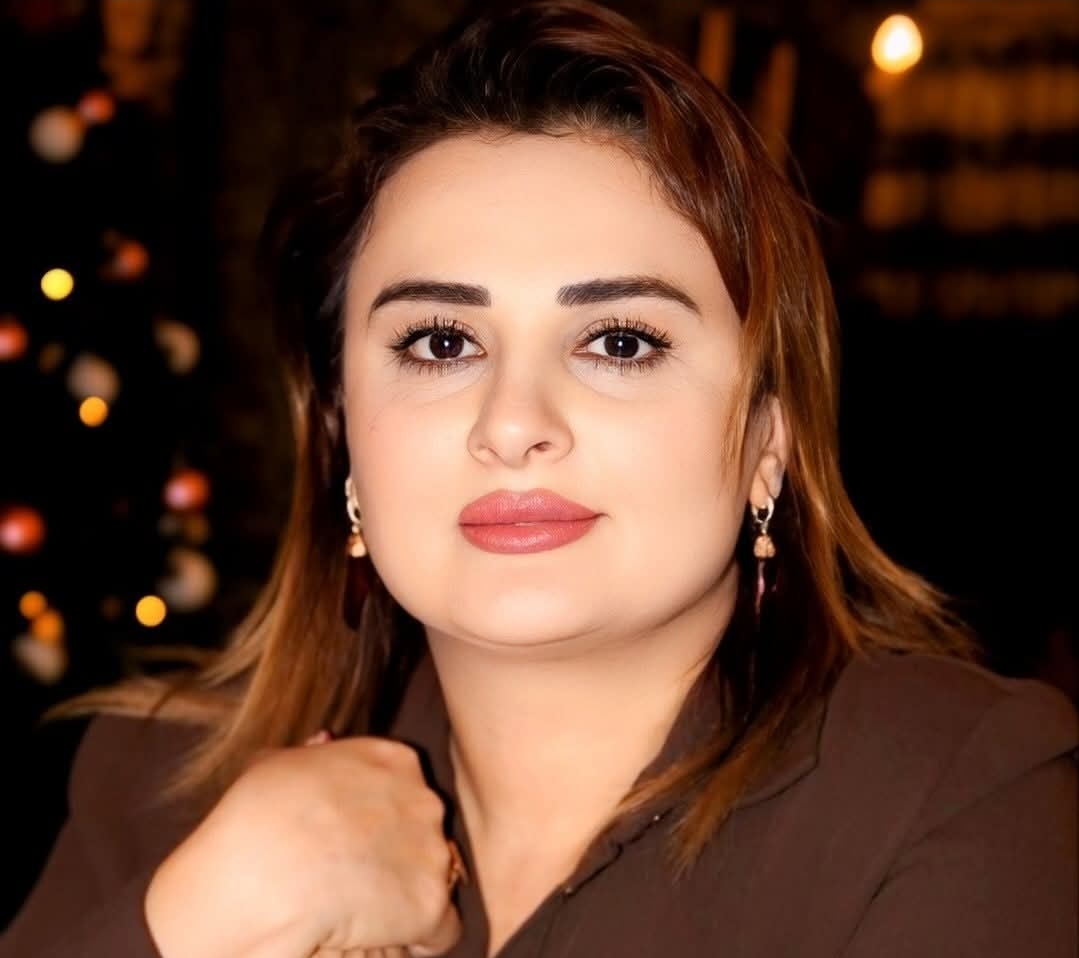
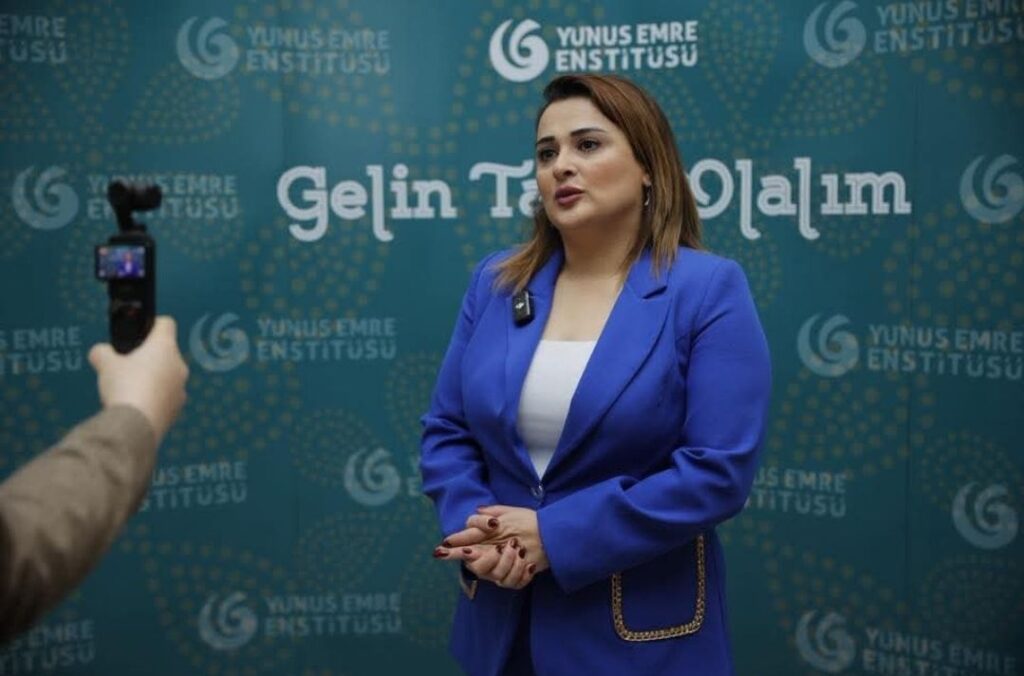
Our interlocutor is one of the bright figures of Azerbaijani literature — poet, publicist, and editor; a member of the Azerbaijan Writers’ Union, the “Yanqi Ovoz” Central Asian Writers’ Union, and the “Iraq-Turkmen Writers and Literary Figures Union”; a recipient of the Presidential Scholarship; laureate of the “Rasul Rza” and “Shakhmar Alakbarzadeh” Literary Awards; Head of the Women’s Wing of the Civil Solidarity Party; and editor of the website Mustaqil.az — Aysel Khanlargizi Safarli.
When speaking about childhood, a person dives into an ocean of both joy and sorrowful memories. When you recall your childhood years, what feelings awaken in your heart first?
My childhood memories always tune me to fragile notes. Whenever I recall them, I return to the carefree, beautiful days when my father was still alive. Back then, little Aysel would show her very first poem to her father, and his kind words would light a small spark of creativity in her heart… I become a child again, and my father gently strokes my hair with eyes full of love… In this flow of emotions, I find myself gazing both into my past and into my own soul.
There is a delicate silence and a deep emotional wave in your poetry.
Where does this silence come from — childhood memories or the turbulence of life?
Some of these feelings come from the fragility of childhood memories, while others were born while rowing against life in the stormy sea of existence, fighting to survive.
Every poet carries an invisible flame within.
Who ignited that fire in you for the first time — what event or which feeling?
— The first torch of poetry within me was lit by my late father. From my earliest years, he took pride in my poems, encouraged me, became my first reader, and always stood behind me… I believe it is a unique happiness for a girl to love her father also as her very first reader.
“Paper planes” — does this symbol represent the purity of childhood or the human need to let dreams fly?
In fact, the origin of “paper planes” is different. Because I lived far away for many years and waited for someone from afar, my life passed through airports filled with longing… In one of my poems, I wrote about how my son, waiting for his father, made paper planes and flew them across the room, turning our home into an airport… That is where the expression “paper planes” was born.
Truth and beauty — how do these two concepts merge in your poetic worldview?
Although truth may sometimes appear ugly to people, in my world it is a form of beauty itself…
Beauty always changes depending on one’s perspective. What matters is the ability to see beautifully. Sometimes a person can feel happiness even in sorrow, can live through pain beautifully, and carry it with dignity.
In the modern world, a woman is simultaneously a creator, a mother, and a leader. How do you maintain the delicate balance between these roles?
I try to maintain it as best as I can. A woman is created so strong and perfect that she can carry the highest emotions of the world with immense love and patience. I am happy that I am both a mother and someone who can express her feelings through writing.
You also lead the Women’s Wing of the Civil Solidarity Party. When literature and social activity intersect, what tones collide within your soul?
The founder of the Civil Solidarity Party is himself a People’s Poet — Sabir Rustamkhanli, a master who gifted priceless works to literature. I believe literature itself is already a form of social activity…
Even the strongest conflicts have often been resolved with a single word. My soul stands in harmony with both my words and my actions; it befriends them, loves both its work and its word.
There are wars, hunger, and injustices in the world. What should a poet do in the face of such pain — remain silent or turn the pen into a sword?
Even if a poet wants to remain silent, they cannot. Poets feel those pains and emotions as if they have lived them themselves. That is why the countless states of the world have always been transformed into poetry, words, and verses — and will continue to be.
In your opinion, is modern literature a remedy for society’s spiritual wounds, or merely consolation?
I believe literature is neither consolation nor a remedy. Literature is the verbal expression of feelings that thousands of people cannot articulate. Literature is the image of emotions, the artistic tones of life. When we are alone with ourselves, it makes us think, sometimes awakens us from heedless sleep, and sometimes gives the human soul the strength to fight. Literature is the nourishment of our spiritual world.

Time changes, technology dominates the human soul. Do you think the value of words still remains in this century?
As long as humans exist, words will exist, and their value will remain. Sometimes a word becomes healing and hope in a sick heart; sometimes it becomes life itself.
There is nothing a word cannot do… Just as with a single word — “dear” — a person is ready to sacrifice their life for the one they love.
They say a person must find the meaning of their life. Where do you see the meaning of life?
Giving meaning to life depends on the individual. When a person sees what they value in the place they desire, life becomes beautiful in their eyes. For a creative person, the meaning of life is to live, to create, and not to grow tired of struggle.
What inspires you most or causes you concern in today’s literary environment?
The emergence of many talented young writers today inspires me greatly. What concerns me are those who devalue words, who seek so-called fame for the sake of publicity and ratings, or who force themselves into being poets or writers. But then I think to myself: time and the scales of literature will weigh every line and every verse; meaningless things that exhaust the agenda will be sifted out and filtered away.
Leaving everything to time is the wisest choice.
Is there a distance between today’s reader and the poet, or do souls still hear one another?
Where there is spiritual kinship, there is no distance. A true reader and one who understands words will feel, sense, and comprehend them anywhere.
Jakhongir NOMOZOV, is a young poet and journalist from Uzbekistan.
He is also a Member of the Union of Journalists of Azerbaijan and the World Young Turkic Writers Union.